
Growth Hormone
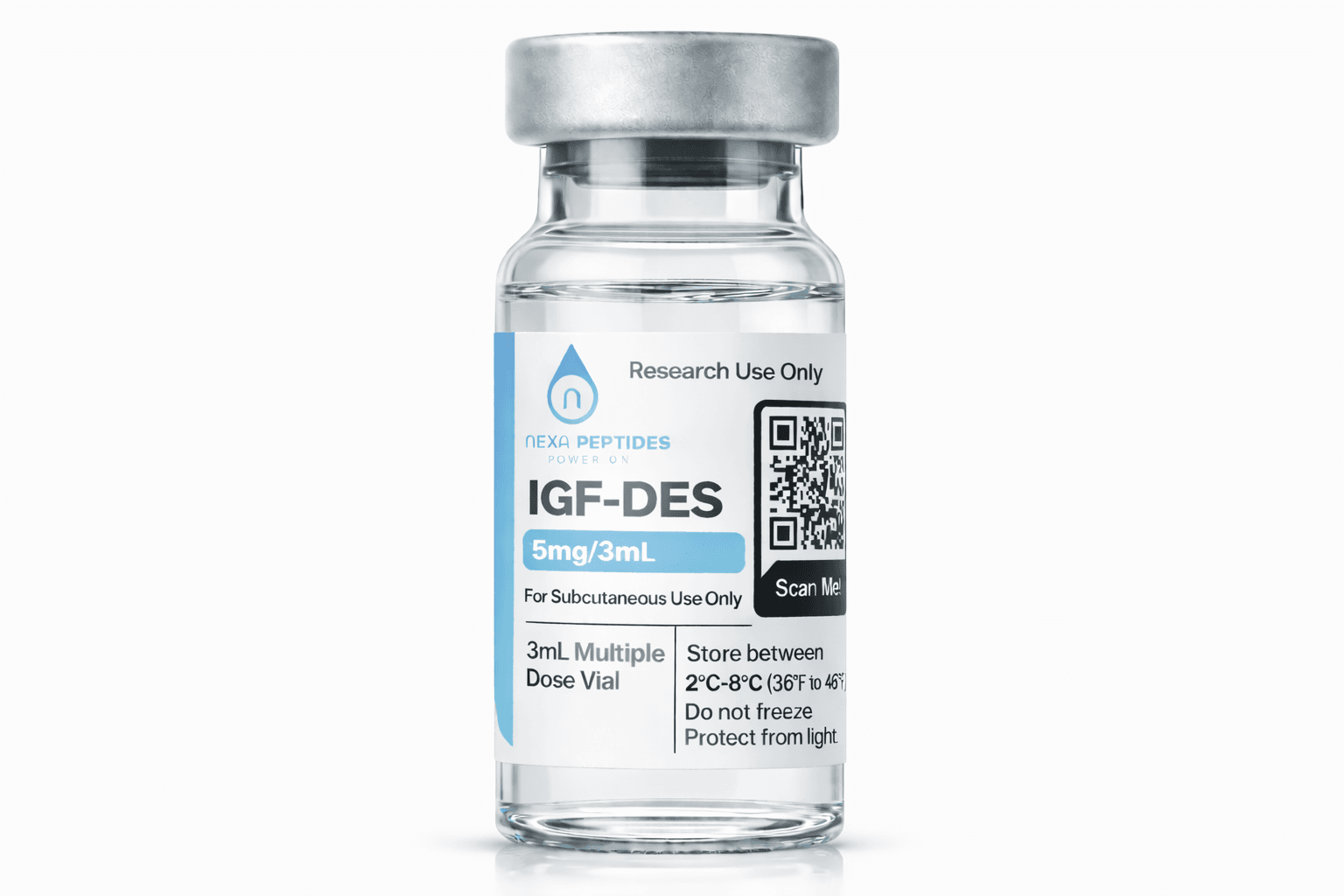
IGF-DES — 2mg
SKU: NXP-IGFD-01
Product Details
IGF-DES, or Des(1-3) IGF-1, is a truncated form of insulin-like growth factor 1 that lacks the first three amino acids of the native sequence. This truncation eliminates binding to most IGF-binding proteins, giving IGF-DES approximately 10 times greater potency than standard IGF-1 in stimulating cell proliferation and receptor activation.
Studies have examined IGF-DES for its rapid and potent activation of the IGF-1 receptor and its downstream signaling cascades including the PI3K/Akt and MAPK pathways. Its short half-life and high receptor affinity make it a useful research tool for studying acute IGF-1 signaling events and localized tissue effects.
Each vial contains highly purified IGF-DES in lyophilized form, produced under strict GMP-adjacent conditions with purity verified at greater than 98% by HPLC. Independent batch analysis ensures reliability across all research applications.
Store lyophilized at -20C. Reconstituted at 2-8C, use within 60 days.
For research and laboratory use only.
About IGF-DES
IGF-DES, also known as des(1-3)IGF-1, is a truncated analog of Insulin-like Growth Factor 1 (IGF-1). This potent research peptide is structurally distinct from its parent molecule, consisting of 67 amino acids instead of the full 70. The designation 'des(1-3)' signifies the deliberate removal of the N-terminal tripeptide sequence: Glycine-Proline-Glutamate. This specific modification is the primary reason for its significant interest within the scientific community, as it profoundly alters the peptide's biochemical behavior and interaction with key regulatory proteins in biological systems.
The full 70-amino acid sequence of human IGF-1 is well-characterized, and IGF-DES represents a precision-engineered variant. The removal of the initial three amino acids drastically reduces its affinity for the family of Insulin-like Growth Factor-Binding Proteins (IGFBPs). In typical physiological models, IGFBPs sequester IGF-1, modulating its bioavailability and half-life. By evading this binding mechanism, IGF-DES exhibits substantially increased bioavailability to interact directly with its target receptor, the IGF-1 receptor (IGF-1R). This characteristic makes it a valuable tool for researchers studying cellular pathways where potent and direct activation of the IGF-1R is desired, without the confounding variable of IGFBP modulation.
This enhanced potency and direct action allow for the investigation of cellular signaling cascades with greater precision. Researchers utilize IGF-DES in a variety of *in vitro* and *in vivo* models to explore processes such as cell proliferation, differentiation, and survival. Its application spans fields from muscle physiology, where it is used to study myogenesis and protein synthesis, to neuroscience, where its neuroprotective potential is examined. The unique properties of IGF-DES provide a distinct advantage for studies aiming to isolate the effects of direct IGF-1 receptor agonism.
At Nexa Peptides, our IGF-DES is synthesized for research purposes only, adhering to the highest standards of purity and quality. It is a critical compound for laboratories investigating the intricate roles of the IGF signaling axis in cellular growth, metabolic regulation, and tissue repair. Its use is strictly intended for qualified researchers conducting preclinical studies. This product is not for human consumption or therapeutic use.
Mechanism of Action
The mechanism of action of IGF-DES is centered on its potent and specific interaction with the Insulin-like Growth Factor 1 Receptor (IGF-1R), a transmembrane receptor tyrosine kinase. The defining feature of IGF-DES, its N-terminal truncation, is key to its enhanced biological activity observed in research models. This modification reduces its binding affinity for Insulin-like Growth Factor-Binding Proteins (IGFBPs) by several orders of magnitude compared to full-length IGF-1. IGFBPs normally function as carrier proteins that sequester IGF-1 in the extracellular matrix and circulation, thereby regulating its access to the IGF-1R. By largely bypassing this sequestration, a greater concentration of free IGF-DES is available to bind and activate the IGF-1R, leading to a more potent cellular response in many experimental systems.
Upon binding to the alpha subunits of the IGF-1R, IGF-DES induces a conformational change that triggers the autophosphorylation of specific tyrosine residues on the intracellular beta subunits of the receptor. This phosphorylation event creates docking sites for various intracellular substrate proteins, primarily the Insulin Receptor Substrate (IRS) family (IRS-1, IRS-2) and Shc (Src homology 2 domain-containing protein). The recruitment and subsequent phosphorylation of these adaptor proteins initiate two principal downstream signaling cascades critical to cellular function.
The first major pathway is the Phosphoinositide 3-kinase (PI3K)/Akt/mTOR pathway, which is central to cell growth, proliferation, and survival. Phosphorylated IRS proteins recruit and activate PI3K, which in turn catalyzes the conversion of phosphatidylinositol (4,5)-bisphosphate (PIP2) to phosphatidylinositol (3,4,5)-trisphosphate (PIP3). PIP3 acts as a second messenger, recruiting and facilitating the activation of protein kinase B (Akt). Activated Akt is a crucial signaling hub that promotes cell survival by phosphorylating and inactivating pro-apoptotic factors like BAD and the FOXO family of transcription factors. Furthermore, Akt activates the mammalian Target of Rapamycin Complex 1 (mTORC1), a master regulator of protein synthesis, which drives cellular growth and anabolism by phosphorylating downstream targets such as S6 kinase (S6K) and eukaryotic initiation factor 4E-binding protein 1 (4E-BP1).
The second critical pathway initiated by IGF-1R activation is the Ras/Raf/MEK/ERK (also known as the MAPK) pathway. This cascade is typically initiated following the recruitment and phosphorylation of Shc. This leads to the activation of the small GTPase Ras, which subsequently triggers a phosphorylation cascade involving Raf, MEK, and finally the Extracellular signal-Regulated Kinases (ERK1/2). The MAPK pathway is primarily involved in mitogenesis, regulating gene expression related to cell proliferation and differentiation. The dual activation of both the PI3K/Akt and MAPK pathways allows IGF-DES to be a powerful tool in research models for studying a wide range of cellular processes, from anabolic effects in muscle and bone cells to neuroprotective actions in neuronal cultures. Its potent, direct agonism of the IGF-1R makes it an invaluable compound for dissecting these complex signaling networks.
Research Applications
IGF-DES is a highly valued compound in preclinical research due to its enhanced potency and direct action on the IGF-1 receptor. Its unique ability to bypass regulation by IGFBPs makes it a precise tool for investigating the direct consequences of IGF-1R signaling in various biological contexts. Laboratory research applications span multiple disciplines, including endocrinology, cell biology, and regenerative medicine, utilizing a range of *in vitro* and *in vivo* models.
One of the most prominent areas of study is in muscle physiology and myogenesis. Researchers use IGF-DES in cell culture models, such as C2C12 myoblasts, to investigate its effects on muscle cell proliferation, differentiation, and hypertrophy. Studies have explored its capacity to stimulate protein synthesis and inhibit protein degradation through the robust activation of the PI3K/Akt/mTOR pathway. In animal models, IGF-DES has been investigated for its potential to mitigate muscle atrophy under catabolic conditions, such as those induced by immobilization or glucocorticoids, providing a model for studying mechanisms of muscle wasting and recovery.
In the field of metabolic research, IGF-DES is studied for its effects on glucose homeostasis and insulin sensitivity. Given the structural and functional homology between the IGF-1 receptor and the insulin receptor, IGF-DES is used to explore insulin-like effects on glucose uptake in peripheral tissues like skeletal muscle and adipose tissue. Preclinical studies in rodent models of metabolic dysfunction or diabetes investigate how potent IGF-1R activation influences systemic glucose metabolism, glycogen synthesis, and lipid metabolism. These studies help elucidate the distinct and overlapping roles of the IGF-1 and insulin signaling pathways.
Furthermore, IGF-DES is a subject of investigation in tissue repair and wound healing. Its potent mitogenic and anti-apoptotic properties are examined in models of injury to various tissues, including skin, bone, and connective tissues. For instance, researchers may apply IGF-DES to fibroblast or osteoblast cultures to study its impact on cell proliferation and extracellular matrix protein synthesis. In animal models of bone fractures or dermal wounds, its local application is investigated to understand its role in accelerating cellular regeneration and improving the quality of tissue repair. These studies provide fundamental insights into the growth-factor-mediated processes that govern healing.
Neuroscience represents another critical area of research for IGF-DES. The IGF-1 signaling pathway is known to be crucial for neuronal development, survival, and plasticity. Researchers utilize IGF-DES in primary neuronal cultures to study its neuroprotective effects against various insults, such as oxidative stress or excitotoxicity. In animal models of ischemic injury or neurodegenerative conditions, IGF-DES is investigated for its potential to promote neuronal survival and synaptic health. These preclinical investigations aim to dissect the molecular mechanisms by which potent IGF-1R activation can support the central and peripheral nervous systems. All such applications are strictly confined to laboratory research settings. For Research Use Only.
Formulation & Handling
Proper handling and storage of IGF-DES are essential to maintain its stability and integrity for research applications. The peptide is supplied as a lyophilized (freeze-dried) powder, which is the most stable form for long-term storage. Lyophilized IGF-DES should be stored in a freezer at or below -20°C. When stored under these conditions, the powder remains stable for an extended period, minimizing degradation before use. For short-term storage prior to reconstitution, refrigeration at 2-8°C is acceptable for several weeks.
Reconstitution should be performed using sterile, high-purity diluents under aseptic laboratory conditions. The recommended solvent for reconstitution is bacteriostatic water (sterile water containing 0.9% benzyl alcohol), which helps prevent microbial contamination after the vial seal is punctured. To reconstitute, slowly inject the desired volume of diluent down the side of the vial, avoiding direct squirting onto the lyophilized powder. Allow the vial to sit for a few minutes, then gently swirl or roll the vial to ensure the peptide dissolves completely. Vigorous shaking should be avoided as it can cause denaturation and damage the peptide's tertiary structure.
Once reconstituted, the IGF-DES solution is less stable than the lyophilized powder and must be handled accordingly. The solution should be stored refrigerated at 2-8°C and is typically stable for a limited duration, often a few weeks. For experiments spanning a longer timeframe, it is best practice to aliquot the freshly reconstituted solution into smaller, single-use volumes in sterile microcentrifuge tubes. These aliquots should be promptly frozen at -20°C or lower. This practice prevents degradation from repeated freeze-thaw cycles, which can compromise the peptide's activity. Always use sterile pipettes and tubes when handling the solution to maintain its purity throughout the course of an experiment.
Quality Standards
At Nexa Peptides, we are committed to providing researchers with IGF-DES of the highest possible quality and purity, ensuring reliable and reproducible experimental outcomes. Our quality assurance protocol is built on a foundation of rigorous analytical testing and adherence to established manufacturing standards. Each batch of IGF-DES undergoes comprehensive analysis to verify its identity and purity. We utilize High-Performance Liquid Chromatography (HPLC) to quantify the purity of the peptide, guaranteeing a purity level of greater than 99%. This ensures that research findings are attributable to the target compound, free from significant impurities.
To confirm the peptide's identity, we employ Mass Spectrometry (MS) analysis. This technique verifies that the molecular weight of the synthesized peptide matches the theoretical mass of the 67-amino acid IGF-DES sequence, confirming that the correct product has been synthesized. Furthermore, each lot is subjected to testing for endotoxins to ensure it is free from bacterial contaminants that could interfere with biological assays, particularly in cell-based and *in vivo* research. Our manufacturing processes are conducted following cGMP (Current Good Manufacturing Practices) guidelines, which ensures consistency, traceability, and quality control from synthesis to final product.
Transparency is a cornerstone of our quality commitment. We provide a third-party Certificate of Analysis (COA) with every batch of IGF-DES. This document offers an unbiased, detailed report of the HPLC and MS results, providing researchers with the independent verification needed to proceed with their studies confidently. Complete lot traceability is maintained for every product, allowing for full accountability and quality tracking. This multi-faceted approach to quality control ensures that the IGF-DES you receive from Nexa Peptides is a reliable and superior-grade reagent for your laboratory research. This product is intended for Research Use Only.
Frequently Asked Questions
What is IGF-DES?
How is IGF-DES synthesized?
What is the molecular weight of IGF-DES?
What research areas use IGF-DES?
How should IGF-DES be stored?
How should IGF-DES be reconstituted for research?
What purity grade is Nexa Peptides' IGF-DES?
Is IGF-DES available with a Certificate of Analysis?
Explore Related Research
Customer Reviews
0 reviews
No reviews yet. Be the first to review this product!