
Growth Hormone
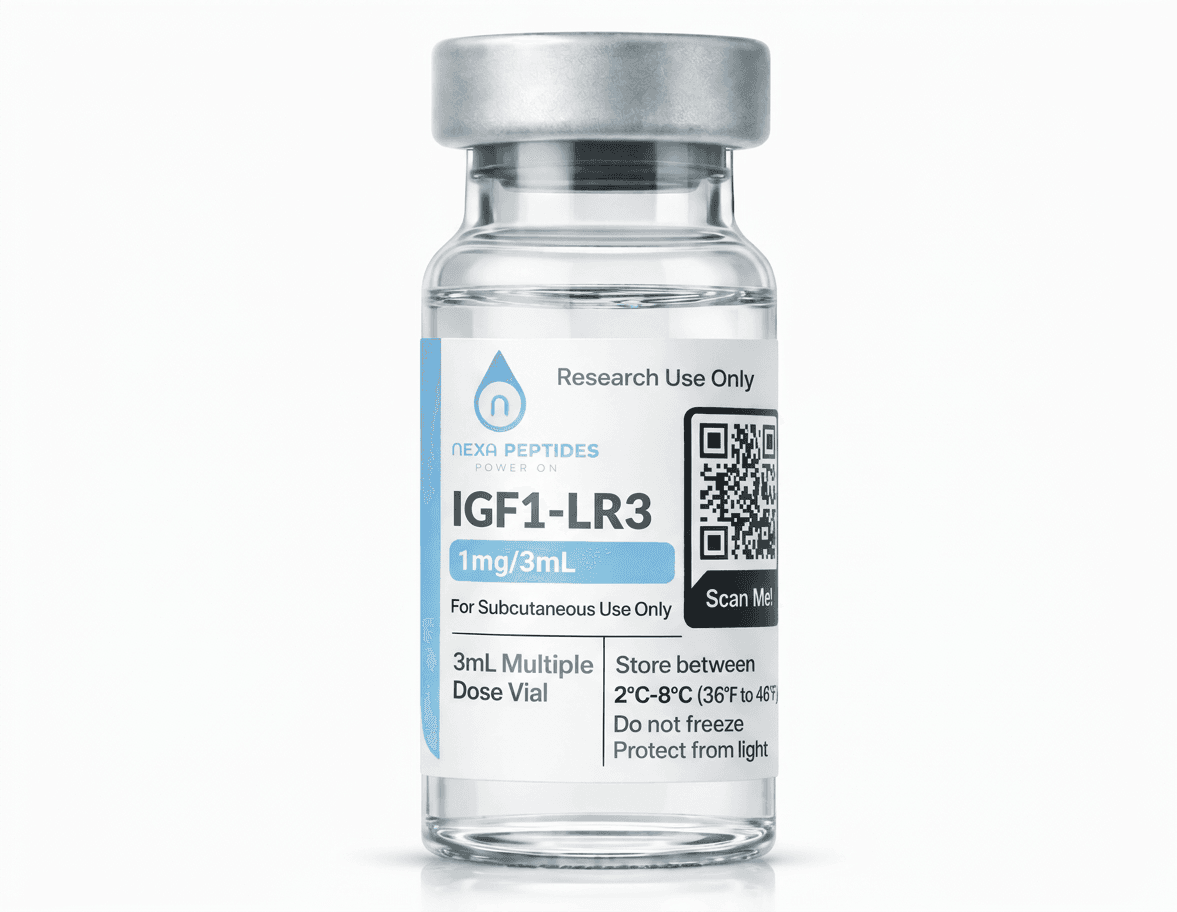
IGF-1 LR3 — IGF1-LR3 1mg
SKU: NXP-IGF1-01
Product Details
IGF1-LR3, or Long R3 Insulin-like Growth Factor 1, is an 83 amino acid analog of human IGF-1 with an arginine substitution at position 3 and a 13 amino acid extension at the N-terminus. These modifications significantly reduce binding to IGF-binding proteins, resulting in a longer half-life and increased bioavailability compared to native IGF-1.
Research has investigated IGF1-LR3 for its potent effects on cell proliferation, protein synthesis, and tissue growth. Its reduced affinity for binding proteins means a greater proportion remains in active free form, making it a powerful tool for studying IGF-1 receptor-mediated signaling pathways and their downstream effects on cellular metabolism.
Each vial contains highly purified IGF1-LR3 in lyophilized form, manufactured to exceed 98% purity as verified by HPLC and mass spectrometry. Stringent quality controls and independent testing guarantee research-grade consistency.
Store lyophilized at -20C. Reconstituted at 2-8C, use within 60 days.
For research and laboratory use only.
About IGF-1 LR3
IGF-1 LR3 is a potent, long-acting synthetic analog of Insulin-like Growth Factor 1 (IGF-1). This single-chain polypeptide, consisting of 83 amino acids, is distinguished from native IGF-1 (70 amino acids) by two critical modifications. The first is a substitution of an arginine (R) for the glutamic acid (E) at the third position of the amino acid sequence. The second is the addition of a 13-amino acid extension peptide at its N-terminus. These structural alterations confer unique biochemical properties that are highly advantageous for research applications, primarily by dramatically reducing its affinity for the family of IGF-binding proteins (IGFBPs).
In biological systems, the activity of native IGF-1 is tightly regulated by IGFBPs, which sequester the growth factor and limit its interaction with its target receptor. By evading this binding, IGF-1 LR3 exhibits a significantly longer plasma half-life and greater bioavailability in preclinical models. This allows for more sustained and potent activation of the IGF-1 receptor (IGF-1R), making it an invaluable tool for researchers investigating the downstream effects of this signaling pathway without the confounding variable of IGFBP modulation. The amino acid sequence of IGF-1 LR3 is MFPAMPLSSL FVNGPRTLCG AELVDALQFV CGDRGFYFNK PTGYGSSSRR APQTGIVDEC CFRSCDLRRL EMYCAPLKPA KSA.
The enhanced stability and potency of IGF-1 LR3 make it a preferred reagent for a wide range of in vitro and in vivo studies. Researchers utilize this peptide to explore fundamental cellular processes, including proliferation, differentiation, and apoptosis. Its primary utility lies in its capacity to specifically and robustly stimulate the IGF-1R, initiating cascades that are central to cellular growth, metabolic control, and tissue homeostasis. Investigating these pathways is critical for understanding mechanisms of myogenesis, neuroprotection, and cellular repair.
Nexa Peptides provides IGF-1 LR3 exclusively for laboratory and research purposes. This product is a high-purity chemical intended for use by qualified scientific professionals in controlled experimental settings. It is not a drug, food, or cosmetic and must not be used for any form of human or therapeutic application. All research conducted with this peptide should adhere to established institutional and regulatory guidelines.
Mechanism of Action
The mechanism of action for IGF-1 LR3 is centered on its function as a high-affinity agonist for the Insulin-like Growth Factor 1 Receptor (IGF-1R), a transmembrane receptor tyrosine kinase. The key to its enhanced potency and prolonged activity in research models lies in its structural modifications, which dramatically lower its affinity for IGF-binding proteins (IGFBPs). Native IGF-1 is largely sequestered by IGFBPs, limiting its bioavailability. IGF-1 LR3, with its R3 substitution and N-terminal extension, largely bypasses this regulatory mechanism, resulting in a higher concentration of free peptide available to bind and activate the IGF-1R.
Upon binding to the extracellular alpha subunits of the dimeric IGF-1R, IGF-1 LR3 induces a conformational change that stimulates the intrinsic tyrosine kinase activity of the intracellular beta subunits. This leads to trans-autophosphorylation of specific tyrosine residues within the receptor's kinase domain. These newly phosphorylated sites serve as high-affinity docking platforms for various intracellular substrate and adaptor proteins, most notably members of the Insulin Receptor Substrate (IRS) family and Shc.
Recruitment and phosphorylation of IRS proteins initiate one of the major downstream signaling arms: the phosphatidylinositol 3-kinase (PI3K)/Akt pathway. Activated IRS binds to the p85 regulatory subunit of PI3K, activating its p110 catalytic subunit. PI3K then phosphorylates phosphatidylinositol (4,5)-bisphosphate (PIP2) to generate phosphatidylinositol (3,4,5)-trisphosphate (PIP3). PIP3 acts as a second messenger, recruiting and activating phosphoinositide-dependent kinase-1 (PDK1) and Akt (also known as Protein Kinase B). Activated Akt is a critical signaling node that promotes cell survival by phosphorylating and inhibiting pro-apoptotic proteins such as BAD and the Forkhead box O (FOXO) family of transcription factors.
Furthermore, Akt activation is a potent stimulus for cell growth and protein synthesis via the mammalian Target of Rapamycin (mTOR) pathway. Akt activates mTOR Complex 1 (mTORC1), which in turn phosphorylates downstream effectors like p70 S6 kinase (S6K1) and eukaryotic initiation factor 4E-binding protein 1 (4E-BP1). This cascade ultimately enhances mRNA translation and ribosome biogenesis, driving cellular hypertrophy. This pathway is a central focus in research on muscle physiology.
A second major signaling cascade activated by the IGF-1R is the Ras/Raf/MEK/ERK (MAPK) pathway. The binding of adaptor proteins like Shc and Grb2 to the phosphorylated receptor leads to the activation of the small GTPase Ras. This triggers a sequential phosphorylation cascade involving Raf, MEK, and finally the Extracellular signal-Regulated Kinases (ERK1/2). The MAPK pathway is primarily mitogenic, translocating to the nucleus to phosphorylate transcription factors that regulate genes involved in cell proliferation and differentiation.
Through these dual signaling pathways, IGF-1 LR3 provides researchers a powerful tool to induce pleiotropic effects, including mitogenesis, cell growth, differentiation, and survival. Its enhanced stability makes it superior to native IGF-1 for in vitro and preclinical studies requiring sustained and quantifiable receptor activation.
Research Applications
IGF-1 LR3 is a widely utilized peptide in biomedical research due to its enhanced stability and potency, allowing for controlled investigation of the IGF-1 signaling axis. Its applications span multiple disciplines, from cellular biology to preclinical models of physiology and disease. A primary area of study is muscle biology, where IGF-1 LR3 is used to probe the molecular mechanisms of skeletal muscle hypertrophy and hyperplasia. In vitro studies using myoblast cell lines, such as C2C12, employ IGF-1 LR3 to stimulate differentiation into myotubes and to analyze the activation of the PI3K/Akt/mTOR pathway, which is fundamental to muscle protein synthesis. In preclinical animal models, research has explored its role in mitigating muscle atrophy resulting from disuse, cachexia, or sarcopenia.
In the field of neuroscience, IGF-1 LR3 serves as a critical tool for investigating the neurotrophic and neuroprotective roles of IGF-1 signaling in the central nervous system. Laboratory studies on primary neuronal cultures or neuroblastoma cell lines use IGF-1 LR3 to examine its effects on neuronal survival, neurite outgrowth, and synaptic plasticity. Its ability to potently activate the PI3K/Akt survival pathway is of particular interest in models of ischemic injury or neurodegenerative conditions. Preclinical research has aimed to understand how sustained IGF-1R activation might influence neurogenesis and cognitive function in various experimental paradigms.
Metabolic research represents another significant application. Given the structural and functional homology between the IGF-1 receptor and the insulin receptor, IGF-1 LR3 is studied for its effects on glucose and lipid metabolism. In vitro experiments on adipocytes and hepatocytes investigate its capacity to stimulate glucose uptake, glycogen synthesis, and modulate insulin sensitivity. These studies help dissect the distinct and overlapping roles of the insulin and IGF-1 signaling pathways in maintaining metabolic homeostasis. The peptide's long-acting nature is particularly useful for long-term cell culture experiments examining metabolic shifts.
The pro-proliferative and anti-apoptotic properties of IGF-1 LR3 have also made it a subject of investigation in the context of tissue repair and wound healing. Research using fibroblast and keratinocyte cell cultures has examined the peptide's ability to promote cell migration and proliferation, essential processes for tissue regeneration. In preclinical wound healing models, studies have assessed how localized administration might influence the rate and quality of tissue repair by stimulating the formation of granulation tissue and re-epithelialization.
Across all these fields, the consistent theme is the use of IGF-1 LR3 as a specific and powerful agonist to elucidate the downstream consequences of IGF-1R activation. All applications described are strictly for preclinical, in vitro, and laboratory research settings. This compound is not intended for human use or any therapeutic purpose.
Formulation & Handling
For optimal long-term stability, lyophilized IGF-1 LR3 should be stored in a freezer at -20°C, protected from light. This ensures the integrity of the peptide powder until it is ready for use in a research setting. For short-term storage prior to reconstitution, refrigeration at 2-8°C is also acceptable.
Reconstitution of the lyophilized powder should be performed using sterile, high-purity diluents appropriate for the experimental protocol, such as bacteriostatic water (containing 0.9% benzyl alcohol) or sterile water. To prevent denaturation of the peptide, the diluent should be slowly injected down the side of the vial. The vial should then be gently swirled or rolled between the fingers until the powder is completely dissolved. Avoid vigorous shaking or sonication, as the mechanical stress can damage the peptide's tertiary structure and reduce its biological activity.
Once reconstituted, the IGF-1 LR3 solution should be stored refrigerated at 2-8°C and is typically stable for a limited period. For research protocols extending over several weeks or months, it is highly recommended to create single-use aliquots of the freshly reconstituted solution. These aliquots should be flash-frozen and stored at -20°C or colder. This practice minimizes repeated freeze-thaw cycles, which can degrade the peptide and compromise experimental reproducibility. Always use aseptic techniques when handling the peptide to prevent microbial contamination.
Quality Standards
Nexa Peptides is committed to providing researchers with IGF-1 LR3 of the highest possible quality and purity to ensure accurate and reproducible experimental outcomes. Each batch of our IGF-1 LR3 is subjected to rigorous quality control analysis. Purity is assessed using High-Performance Liquid Chromatography (HPLC), with every lot guaranteed to exceed a purity level of 99%. This analytical technique separates, identifies, and quantifies each component in the mixture, confirming the absence of significant impurities.
To verify the peptide's identity and structural integrity, we utilize Mass Spectrometry (MS). This analysis confirms that the molecular weight of the synthesized peptide matches its theoretical mass based on its 83-amino acid sequence, ensuring that the correct product has been synthesized. Furthermore, each batch is tested for endotoxin levels to ensure it is safe for use in sensitive in vitro cell culture and preclinical in vivo research models. Our peptides are synthesized in a cGMP (Current Good Manufacturing Practice)-compliant facility, following strict protocols for quality and consistency.
We provide complete transparency to our research clients. A third-party Certificate of Analysis (COA) is available for every lot of IGF-1 LR3, detailing the results of HPLC and MS analyses. This independent verification offers an additional layer of confidence in the product's quality. Each vial is labeled with a unique lot number, enabling full traceability from the synthesis stage to final delivery, reinforcing our commitment to scientific integrity and quality assurance.
Frequently Asked Questions
What is IGF-1 LR3?
How is IGF-1 LR3 synthesized?
What is the molecular weight of IGF-1 LR3?
What research areas use IGF-1 LR3?
How should IGF-1 LR3 be stored?
How should IGF-1 LR3 be reconstituted for research?
What purity grade is Nexa Peptides' IGF-1 LR3?
Is IGF-1 LR3 available with a Certificate of Analysis?
Explore Related Research
Customer Reviews
0 reviews
No reviews yet. Be the first to review this product!