

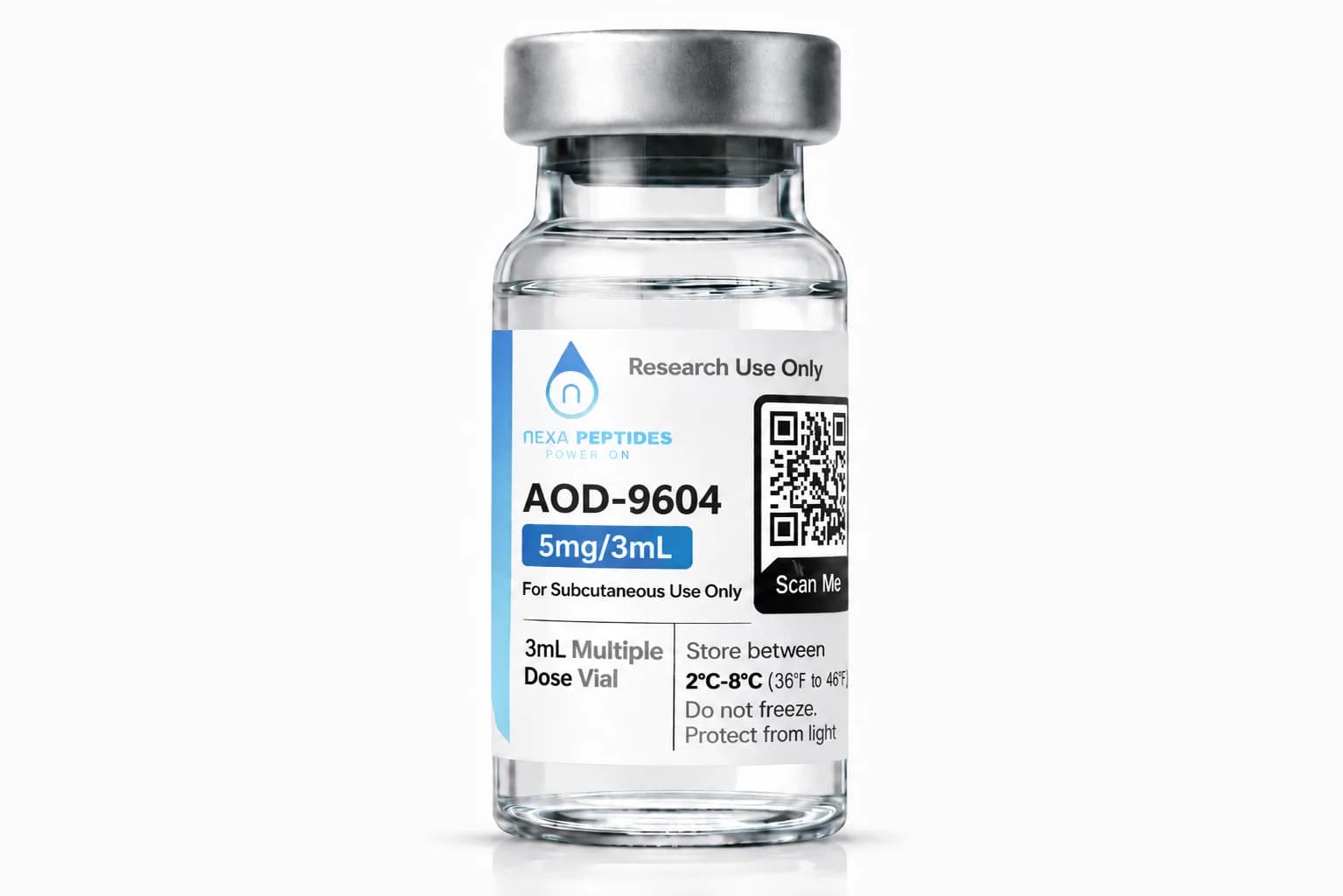
Anti Aging
AOD-9604 — AOD-9604
SKU: NXP-AOD-005
AOD-9604 is a 16-amino-acid synthetic fragment corresponding to the lipolytic domain of the human growth hormone C-terminus (residues 177-191), studied for its effects on adipose tissue metabolism in preclinical models.
Product Details
AOD-9604 is a modified analog of human growth hormone (hGH) that exhibits significant fat-reducing and metabolic-regulating properties in research environments. This peptide consists of the C-terminus fragment of hGH, which has been altered to enhance its lipolytic effects without the accompanying growth-promoting actions of full-length hGH. AOD-9604 has been shown to stimulate the breakdown of triglycerides and inhibit the formation of new fat cells, particularly within adipose tissue in non-human test subjects. Furthermore, research indicates its ability to promote a shift in the metabolic profile of subjects, improving fat utilization while preserving lean muscle mass in non-human test subjects. Through molecular signaling pathways, AOD-9604 interacts with the hypothalamic-pituitary-adrenal axis and influences key metabolic regulators, such as leptin and insulin sensitivity.
RESEARCH AND LABORATORY USE ONLY
About AOD-9604
AOD-9604, also referred to as the Anti-Obesity Drug fragment or hGH fragment 176-191, is a 16-amino-acid synthetic peptide engineered to replicate the C-terminal lipolytic domain of native human growth hormone (hGH). The molecule was originally developed at Monash University and advanced by Metabolic Pharmaceuticals as a candidate compound for investigating the metabolic functions of hGH while attempting to dissociate those effects from the broader systemic actions of the full-length hormone. Structurally, AOD-9604 corresponds to residues 177-191 of hGH with an added N-terminal tyrosine residue and retains the internal disulfide bridge between the two cysteines that is critical to its bioactive conformation.
Mechanistically, AOD-9604 is studied in preclinical models for its capacity to stimulate lipolysis (the breakdown of triglycerides) and inhibit lipogenesis (the synthesis of new fat) in adipocytes, particularly in visceral adipose tissue. Unlike intact growth hormone, available preclinical data indicate that AOD-9604 does not measurably elevate circulating insulin-like growth factor 1 (IGF-1), nor does it appear to disrupt glucose homeostasis or insulin sensitivity in animal models. This pharmacological profile has made the fragment a useful tool for researchers seeking to interrogate the lipolytic axis of growth hormone signaling in isolation from its somatogenic and glycemic effects.
Nexa Peptides supplies AOD-9604 as a sterile lyophilized powder verified to greater than 99% purity by reversed-phase high-performance liquid chromatography (HPLC), with identity confirmed by mass spectrometry. Each lot is accompanied by a third-party Certificate of Analysis documenting purity, mass, and appearance. This material is intended strictly for in vitro and in vivo laboratory research and is not for human or veterinary use.
Mechanism of Action
The proposed mechanism of action of AOD-9604 centers on its capacity to engage the lipolytic signaling pathway downstream of beta-3 adrenergic receptor activity in adipocytes. Preclinical research using murine adipose tissue and isolated fat cells suggests that the fragment promotes the translocation and activation of hormone-sensitive lipase (HSL) and upregulates expression of beta-3 adrenergic receptors on the surface of white and brown adipocytes. The downstream consequence in these models is enhanced hydrolysis of stored triacylglycerols into free fatty acids and glycerol, which are subsequently mobilized for beta-oxidation in the mitochondria.
A second arm of the proposed mechanism involves the suppression of lipogenic enzymes. In rodent models, administration of AOD-9604 has been associated with decreased activity of acetyl-CoA carboxylase and fatty acid synthase in adipose tissue, reducing the conversion of carbohydrate-derived carbons into newly synthesized fatty acids. The net effect observed in these preclinical systems is a shift in adipocyte energy balance toward lipid catabolism and away from lipid storage, without the parallel induction of hepatic gluconeogenesis or insulin resistance that can accompany full-length growth hormone exposure.
Importantly, AOD-9604 is not believed to act through the canonical growth hormone receptor (GHR) in the same manner as intact hGH. Receptor binding studies have generally failed to demonstrate strong affinity of the fragment for the GHR, and the absence of measurable IGF-1 elevation in treated animals is consistent with a non-classical signaling pathway. The exact receptor or accessory binding partner that mediates the lipolytic effect of AOD-9604 remains an active area of investigation, and elucidating this pathway is one of the primary research applications of the compound in academic and preclinical laboratories.
Research Applications
AOD-9604 is widely used in preclinical laboratories as a probe for dissecting the lipolytic and metabolic functions of growth hormone signaling. In adipose-tissue research, investigators administer the fragment to murine models of diet-induced obesity, ob/ob mice, and db/db mice to evaluate changes in body composition, adipocyte size distribution, and the molecular signatures of lipolysis. Endpoints commonly include phosphorylation status of hormone-sensitive lipase, expression of perilipin and adipose triglyceride lipase, and quantification of free fatty acid and glycerol release from explanted adipose tissue.
A second important research domain involves the use of AOD-9604 in in vitro adipocyte models, including 3T3-L1 cells, primary human and murine adipocytes, and stromal vascular fraction cultures. These systems allow researchers to characterize dose-response relationships, intracellular signaling cascades (including cAMP/PKA activity), and crosstalk with insulin and catecholamine signaling. The fragment is also studied in brown and beige adipocyte models for its potential influence on uncoupling protein 1 (UCP1) expression and thermogenic capacity.
Beyond adipose research, AOD-9604 has been investigated in preclinical cartilage and osteoarthritis models. Animal studies and in vitro chondrocyte cultures have explored whether the fragment, alone or in combination with other compounds such as hyaluronic acid, can influence cartilage matrix synthesis and chondrocyte proliferation. These investigations have positioned AOD-9604 as a multifunctional research tool with relevance to metabolic and musculoskeletal preclinical science. All such applications are strictly for non-clinical research purposes. For Research Use Only.
Formulation & Handling
For optimal stability and integrity, lyophilized AOD-9604 powder should be stored in a freezer at temperatures between -20°C and -80°C. The vial must be kept tightly sealed and protected from exposure to light and moisture to prevent oxidation of the cysteine disulfide bridge and other degradation pathways. Properly stored lyophilized material retains potency for the duration of its labeled shelf life.
Reconstitution of lyophilized AOD-9604 should be performed under sterile conditions using bacteriostatic water for injection or sterile deionized water as specified by the research protocol. The solvent should be added gently down the inner wall of the vial to minimize foaming and shear stress on the peptide. The vial should then be swirled gently or inverted until the powder is fully dissolved. Vigorous shaking should be avoided, as mechanical stress can denature peptide secondary structure.
Once reconstituted, AOD-9604 solution should be stored at 2-8°C for short-term use (typically up to several weeks) or aliquoted into single-use volumes in sterile, low-protein-binding tubes and frozen at -20°C for longer-term storage. Repeated freeze-thaw cycles should be avoided to preserve peptide integrity. Researchers should always refer to the lot-specific Certificate of Analysis for precise handling and stability data applicable to the batch in hand.
Quality Standards
Nexa Peptides is committed to providing researchers with high-quality AOD-9604 suitable for rigorous laboratory investigation. The purity of each lot is quantitatively determined using reversed-phase High-Performance Liquid Chromatography (HPLC), with a guaranteed purity level of greater than 99%. This ensures that researchers are working with a compound free from significant impurities that could confound experimental results or introduce variability into dose-response measurements.
To further validate the product, the identity and molecular weight of our AOD-9604 are confirmed using Mass Spectrometry (MS), providing unambiguous verification of the chemical structure. Additionally, each batch is screened for endotoxin levels, which is particularly important for researchers conducting cell-culture experiments where endotoxin contamination can elicit confounding inflammatory responses. Manufacturing is conducted in accordance with current good manufacturing practices to ensure batch-to-batch consistency.
Every purchase of AOD-9604 is accompanied by a comprehensive, lot-specific Certificate of Analysis (COA). This document details the results of third-party analytical testing, including HPLC purity, MS identity confirmation, and visual appearance. This commitment to transparency provides researchers with the documentation needed to support experimental reproducibility and publication standards. This product is sold for Research Use Only.
Frequently Asked Questions
What is AOD-9604?
How does AOD-9604 differ from human growth hormone?
What is the molecular weight of AOD-9604?
What research areas use AOD-9604?
How should AOD-9604 be stored?
How should AOD-9604 be reconstituted for research?
What purity grade is Nexa Peptides AOD-9604?
Is AOD-9604 available with a Certificate of Analysis?
Explore Related Research
Customer Reviews
0 reviews
No reviews yet. Be the first to review this product!