
Weight Loss
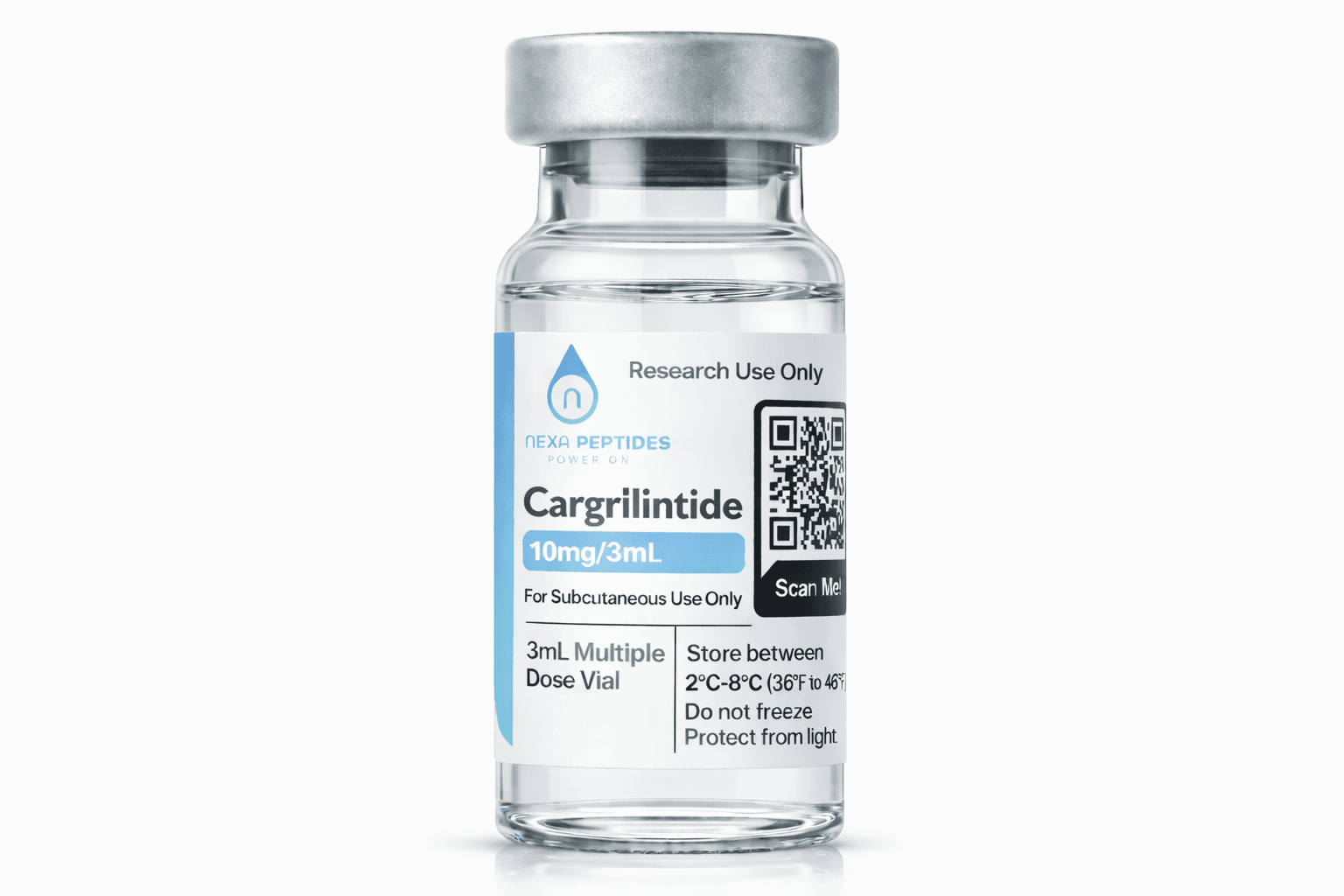
Cagrilintide — Cargrilintide 10mg
SKU: NXP-CARG-01
Product Details
Cargrilintide is a long-acting amylin analog designed for metabolic research. As a synthetic derivative of the naturally occurring pancreatic hormone amylin, it has been developed to investigate amylin receptor-mediated pathways in appetite regulation and energy balance.
Research has focused on how cargrilintide activates amylin receptors in the area postrema and other central nervous system regions involved in satiety signaling. Preclinical and clinical research studies have examined its effects on gastric emptying, glucagon secretion, and food intake. Its extended half-life compared to native amylin makes it particularly useful for studying sustained receptor activation and its downstream metabolic consequences.
Each vial contains research-grade lyophilized Cargrilintide, produced under GMP conditions with purity exceeding 98% as verified by HPLC analysis. Quality control includes mass spectrometry and endotoxin testing. Certificate of analysis available upon request.
Storage: Store lyophilized at -20°C. Reconstituted at 2-8°C, use within 60 days.
For research and laboratory use only.
About Cagrilintide
Cagrilintide is a long-acting, acylated analogue of the human pancreatic hormone amylin, developed exclusively for in vitro and in vivo research applications. Amylin, a 37-amino acid peptide, is co-secreted with insulin by pancreatic β-cells and plays a crucial role in glucose homeostasis and appetite regulation. However, native amylin's tendency to aggregate into amyloid fibrils and its short plasma half-life limit its utility in sustained laboratory investigations. Cagrilintide was engineered to overcome these limitations. Its structure incorporates specific amino acid substitutions to enhance solubility and prevent fibril formation, along with the addition of a C18 fatty diacid moiety via a linker. This acylation facilitates reversible binding to serum albumin, creating a circulating depot that significantly extends its pharmacokinetic profile, making it an ideal tool for long-term metabolic studies in preclinical models.
The primary focus of Cagrilintide research is in the fields of endocrinology, metabolism, and neuroscience. As a potent amylin receptor agonist, it allows investigators to probe the physiological pathways governed by amylin signaling with greater precision and duration. Its effects on satiety, gastric emptying, and postprandial glucagon secretion are subjects of intense study. Researchers utilize Cagrilintide to explore the complex interplay between the central and peripheral nervous systems in the regulation of energy balance.
Of particular note is the investigation of Cagrilintide in combination with other metabolic peptides, most prominently Glucagon-Like Peptide-1 (GLP-1) receptor agonists. Preclinical studies are designed to elucidate potential synergistic effects on appetite suppression and body weight regulation when activating both the amylinergic and incretin pathways simultaneously. This research paradigm provides a powerful model for understanding multi-hormonal approaches to metabolic control. Nexa Peptides provides high-purity Cagrilintide (>99% via HPLC) to ensure reproducible and accurate results for these demanding research applications. This product is strictly intended for laboratory and research use only.
Mechanism of Action
The mechanism of action of Cagrilintide is centered on its function as a potent and selective agonist of the amylin receptor (AMY). The AMY receptor is a heterodimeric G-protein coupled receptor (GPCR) complex, composed of the calcitonin receptor (CTR) core and one of three Receptor Activity-Modifying Proteins (RAMP1, RAMP2, or RAMP3). The specific RAMP subtype co-expressed with the CTR determines the ligand-binding affinity and specificity, with AMY1 (CTR + RAMP1) and AMY3 (CTR + RAMP3) being the primary targets for amylin analogues.
Cagrilintide's primary site of action for appetite regulation is the area postrema (AP), a sensory circumventricular organ in the hindbrain that lacks a complete blood-brain barrier. Neurons within the AP express a high density of AMY receptors. Upon binding, Cagrilintide activates the Gαs subunit of the GPCR complex, stimulating adenylyl cyclase. This enzyme catalyzes the conversion of ATP to cyclic AMP (cAMP), a key second messenger. The subsequent elevation in intracellular cAMP levels activates Protein Kinase A (PKA). PKA, in turn, phosphorylates numerous downstream intracellular proteins, including ion channels and transcription factors, leading to the modulation of neuronal excitability. This signaling cascade within the AP and the nucleus of the solitary tract (NTS) is believed to be the primary mechanism for inducing feelings of satiety and reducing food intake.
In addition to its central effects, Cagrilintide exhibits peripheral actions that contribute to its overall metabolic profile observed in research models. It has been shown to delay gastric emptying, a physiological effect mediated by amylin receptors in the gastrointestinal tract and vagal nerve pathways. By slowing the rate at which nutrients enter the small intestine, Cagrilintide helps regulate postprandial glucose excursions. Furthermore, it suppresses the secretion of glucagon from pancreatic α-cells, particularly in hyperglycemic states, an action that complements the glucose-lowering effects of insulin. This multifaceted mechanism, targeting both central appetite centers and peripheral glucose control points, makes it a subject of significant interest in metabolic research.
The long-acting property of Cagrilintide is a direct result of its chemical structure. The attached fatty diacid chain allows it to bind non-covalently to circulating albumin. This binding sequesters the peptide, protecting it from rapid enzymatic degradation and renal clearance, thereby extending its plasma half-life to several days. This sustained exposure ensures prolonged and stable activation of AMY receptors, a critical feature for studies investigating chronic metabolic regulation in animal models.
Research Applications
Cagrilintide is a specialized peptide exclusively utilized in preclinical research settings to investigate metabolic regulation, obesity, and type 2 diabetes. Its primary application is in studies designed to understand the role of the amylinergic system in controlling energy homeostasis. Researchers employ Cagrilintide in various in vivo animal models, including diet-induced obese (DIO) rodents and genetic models of metabolic dysfunction, to characterize its effects on key physiological endpoints. These studies typically measure changes in body weight, cumulative food intake, body composition (fat mass vs. lean mass), and energy expenditure over extended periods.
The most prominent area of investigation involves the synergistic potential of Cagrilintide when studied in combination with GLP-1 receptor agonists. Laboratory research explores how the co-administration of these two classes of peptides impacts metabolic outcomes. These studies are designed to test the hypothesis that activating distinct, yet complementary, neurohormonal pathways—the hindbrain-centric amylin pathway and the forebrain/hypothalamic GLP-1 pathway—can produce additive or synergistic effects on appetite suppression and weight reduction. Experimental protocols often involve comparing the effects of Cagrilintide alone, a GLP-1 agonist alone, and the combination of both in well-controlled animal cohorts.
Beyond body weight, research applications extend to the study of glycemic control. Investigators use Cagrilintide in models of type 2 diabetes to assess its impact on parameters such as fasting glucose, insulin sensitivity, and HbA1c levels. Oral glucose tolerance tests (OGTTs) are frequently performed in these studies to evaluate the peptide's influence on postprandial glucose disposal and its glucagon-suppressive effects. These investigations provide insight into the potential of amylin agonism to contribute to comprehensive glucose management strategies in experimental contexts.
In vitro studies are also a critical component of Cagrilintide research. Cell-based assays using cell lines engineered to express specific amylin receptor subtypes (e.g., AMY1, AMY3) are used to determine binding affinities, receptor activation profiles, and downstream signaling events (e.g., cAMP accumulation). These molecular-level experiments are essential for characterizing the pharmacological profile of Cagrilintide and comparing it to native amylin or other analogues. Such research helps to elucidate the structure-activity relationships that govern its potency and efficacy, contributing to a deeper understanding of metabolic endocrinology. All studies involving Cagrilintide are conducted under strict laboratory protocols and are for research purposes only.
Formulation & Handling
For optimal stability and performance in research applications, Cagrilintide is supplied as a lyophilized (freeze-dried) white powder. In its lyophilized form, the peptide should be stored in a freezer at or below -20°C to prevent degradation and maintain its integrity over the long term. Before use, the vial should be allowed to equilibrate to room temperature to reduce condensation upon opening.
Reconstitution should be performed using sterile, high-purity diluents under aseptic conditions. The recommended solvent is bacteriostatic water (containing 0.9% benzyl alcohol), which helps maintain sterility for multiple uses from the same vial. Alternatively, sterile water or an appropriate sterile buffer solution can be used, depending on the specific experimental protocol. To reconstitute, slowly inject the desired volume of diluent down the side of the vial to avoid foaming. Do not shake the vial vigorously. Instead, gently swirl or rotate the vial until the powder is completely dissolved. Full dissolution should be confirmed by visual inspection.
Once reconstituted, the Cagrilintide solution should be stored refrigerated at 2-8°C and is typically stable for a limited period. For long-term studies, it is highly recommended to aliquot the freshly reconstituted solution into smaller, single-use volumes and store them frozen at -20°C. This practice minimizes the number of freeze-thaw cycles, which can degrade the peptide and compromise experimental results. Avoid repeated temperature fluctuations to ensure the consistency and reliability of your research data. Always handle with appropriate personal protective equipment in a laboratory setting.
Quality Standards
Nexa Peptides is committed to providing researchers with the highest quality Cagrilintide for their laboratory investigations. Each batch of our Cagrilintide is produced in accordance with stringent quality control protocols to ensure superior purity, identity, and consistency. The peptide is synthesized using automated solid-phase peptide synthesis (SPPS) technology and is meticulously purified using preparative High-Performance Liquid Chromatography (HPLC). We guarantee a purity level of greater than 99% as determined by analytical HPLC, ensuring that your experiments are conducted with a precisely defined research compound, free from significant impurities.
To confirm the identity and structural integrity of the peptide, each batch undergoes Mass Spectrometry (MS) analysis. This analysis verifies that the molecular weight of the synthesized peptide matches its theoretical mass, confirming the correct amino acid sequence and the successful conjugation of the acylated side chain. Furthermore, our Cagrilintide is tested for endotoxin levels to ensure it is suitable for use in sensitive in vitro cell culture and in vivo animal model studies. Rigorous lot-to-lot traceability is maintained throughout the manufacturing process, from raw materials to the final lyophilized product.
For complete transparency and to support the rigor of your research, a comprehensive, third-party Certificate of Analysis (COA) is available for every batch of Cagrilintide. The COA provides detailed results from HPLC and MS analyses, confirming the purity and identity of the product you receive. This commitment to quality ensures that researchers can have full confidence in the reliability and reproducibility of their experimental outcomes when using Nexa Peptides' products. All products are supplied for Research Use Only (RUO).
Frequently Asked Questions
What is Cagrilintide?
How is Cagrilintide synthesized?
What is the molecular weight of Cagrilintide?
What research areas use Cagrilintide?
How should Cagrilintide be stored?
How should Cagrilintide be reconstituted for research?
What purity grade is Nexa Peptides' Cagrilintide?
Is Cagrilintide available with a Certificate of Analysis?
Explore Related Research
Customer Reviews
0 reviews
No reviews yet. Be the first to review this product!