

Skin & Hair
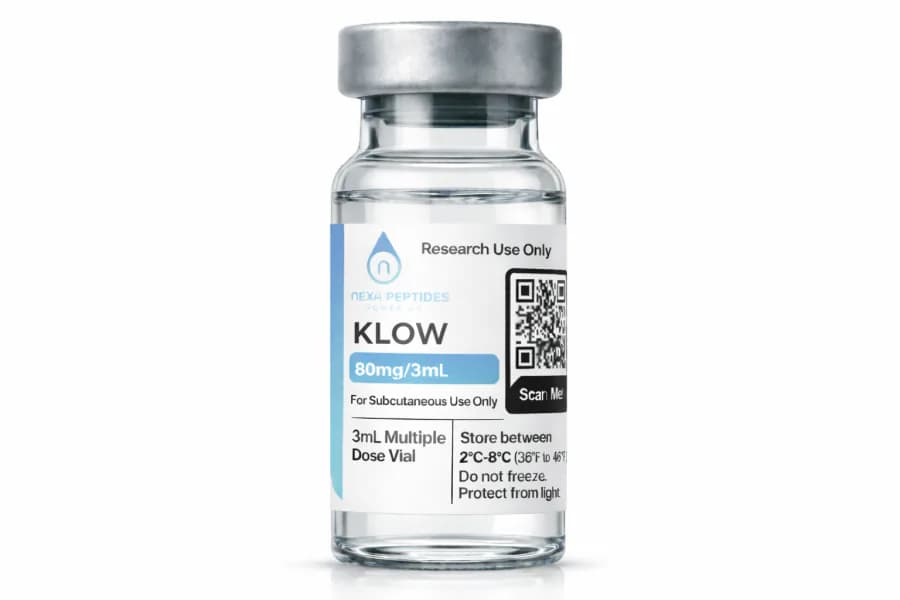
KLOW Peptide Blend — - 80mg
SKU: NXP-KLW-80
Combines GHK-Cu, TB-500, BPC-157, and KPV to support tissue regeneration, wound healing, and inflammation reduction in research. For research use only.
Product Details
KLOW Peptide Blend is an 80mg multi-peptide research formulation combining four complementary peptide sequences for advanced studies in tissue regeneration, wound healing, and extracellular matrix remodeling. This blend is designed for researchers investigating the synergistic interactions between peptides that individually target different aspects of the repair cascade.
Preclinical models have utilized multi-peptide approaches to study enhanced collagen deposition, angiogenesis modulation, inflammatory cytokine regulation, and stem cell recruitment. The KLOW blend enables investigation of these overlapping pathways within a single experimental framework, reducing the complexity of multi-agent dosing protocols.
Manufactured with each component peptide individually verified by HPLC (purity >98%) and mass spectrometry before blending. Final product undergoes additional quality checks including endotoxin testing and sterility verification. Certificate of analysis available for each lot.
Store lyophilized at -20°C. Reconstituted at 2-8°C, use within 60 days. Avoid repeated freeze-thaw cycles to maintain peptide integrity.
For research and laboratory use only.
About KLOW Peptide Blend
The KLOW Peptide Blend represents a novel investigational tool designed for advanced metabolic research. It is a precisely formulated combination of two distinct synthetic peptide analogs engineered to synergistically target key pathways in energy homeostasis. This blend is not a naturally occurring sequence but a purpose-built molecule for preclinical studies investigating the complex interplay between central appetite regulation and peripheral energy expenditure. The blend comprises a GLP-1/GIP receptor co-agonist fragment and a peptide designed to modulate mitochondrial bioenergetics, providing a multi-pronged approach for studying metabolic control in laboratory settings.
Supplied as a lyophilized white powder, the KLOW Peptide Blend ensures stability and a long shelf-life, allowing for accurate and reproducible reconstitution for experimental use. Its development was driven by the need for sophisticated research agents capable of simultaneously influencing both incretin signaling, which is central to glucose metabolism and satiety, and cellular respiration, the fundamental process of energy conversion. This dual-action profile makes it a subject of significant interest in studies utilizing in vitro cell models and in vivo animal models of metabolic dysfunction.
Researchers investigating metabolic syndrome, obesity, and type 2 diabetes may find the KLOW Peptide Blend to be a valuable compound for elucidating underlying pathophysiological mechanisms. Its unique design allows for the exploration of how combined signaling at incretin receptors and direct influence on mitochondrial efficiency can impact parameters such as glucose tolerance, insulin sensitivity, body composition, and overall energy balance. All research conducted with this peptide should adhere to strict laboratory safety protocols.
Nexa Peptides provides this blend exclusively for research purposes. This product is not intended for human or veterinary use. It is a powerful chemical tool for qualified scientific and medical researchers to probe the frontiers of metabolic science. Each batch is rigorously tested to ensure the highest standards of purity and identity, empowering researchers with a reliable and consistent product for their studies. For Research Use Only.
Mechanism of Action
The mechanism of action for the KLOW Peptide Blend is multifaceted, stemming from the distinct yet complementary activities of its constituent peptide components. This synergistic action is designed to be investigated in preclinical research models of metabolic regulation. The first component is an engineered peptide fragment acting as a co-agonist at both the glucagon-like peptide-1 receptor (GLP-1R) and the glucose-dependent insulinotropic polypeptide receptor (GIPR). Both are Class B G-protein coupled receptors (GPCRs) predominantly expressed in pancreatic islets, the gastrointestinal tract, and key regions of the central nervous system, including the hypothalamus.
Upon binding to GLP-1R and GIPR, this component initiates a signaling cascade via the Gαs subunit, leading to the activation of adenylyl cyclase. This enzyme catalyzes the conversion of ATP to cyclic AMP (cAMP), a critical second messenger. Elevated intracellular cAMP levels activate Protein Kinase A (PKA) and Exchange Protein Activated by cAMP 2 (EPAC2). In pancreatic β-cells, this cascade potentiates glucose-dependent insulin secretion, a primary mechanism for improving glycemic control studied in metabolic research. Concurrently, activation of these receptors in the hypothalamus, particularly on pro-opiomelanocortin (POMC) neurons, is hypothesized to suppress appetite and promote satiety, a key area of investigation in models of obesity.
The second component of the KLOW Peptide Blend is a novel peptide sequence designed to modulate mitochondrial bioenergetics. Its proposed mechanism involves interaction with proteins of the inner mitochondrial membrane, potentially mimicking the function of endogenous uncoupling proteins (UCPs). By facilitating a controlled proton leak across the inner mitochondrial membrane, this peptide partially dissipates the proton motive force. This action uncouples substrate oxidation from ATP synthesis via ATP synthase. Consequently, the energy stored in the electrochemical gradient is released as heat, a process known as thermogenesis.
This uncoupling effect necessitates an increase in substrate oxidation (e.g., fatty acids and glucose) to maintain the proton gradient required for basal ATP production and cellular function. The resulting shift in the cellular energy state, characterized by a lower ATP:ADP ratio, acts as a potent activator of AMP-activated protein kinase (AMPK). Activated AMPK is a master metabolic regulator that promotes catabolic pathways, such as fatty acid oxidation and glycolysis, while inhibiting anabolic processes like lipogenesis and protein synthesis. This peripheral mechanism focuses on increasing total daily energy expenditure (TDEE) within research models.
The combined theoretical effect of the KLOW Peptide Blend is therefore a comprehensive modulation of energy balance. The incretin co-agonist component is studied for its effects on reducing energy intake (via central satiety signals) and improving nutrient handling (via enhanced insulin action and delayed gastric emptying). Simultaneously, the mitochondrial modulator component is investigated for its capacity to increase energy output (via thermogenesis and enhanced fatty acid oxidation). This dual mechanism provides a powerful tool for researchers to study integrated metabolic control systems in a laboratory context.
Research Applications
The KLOW Peptide Blend is intended exclusively for in vitro and in vivo research applications, particularly in the fields of endocrinology, metabolism, and cellular bioenergetics. Its unique dual-action mechanism makes it a subject of investigation for a wide range of preclinical studies aimed at understanding and modeling complex metabolic diseases.
One primary area of application is in animal models of obesity and metabolic syndrome. Researchers utilize diet-induced obesity (DIO) models, typically in rodents like C57BL/6J mice fed a high-fat diet, to study the effects of the KLOW Peptide Blend on body weight, adiposity, and food intake. Such studies often involve quantifying changes in fat mass versus lean mass using techniques like dual-energy X-ray absorptiometry (DEXA) and monitoring metabolic rate through indirect calorimetry. The goal is to dissect the relative contributions of reduced caloric intake versus increased energy expenditure to the overall observed effects on body composition.
In the context of type 2 diabetes research, the blend is investigated in genetic models of insulin resistance and hyperglycemia, such as the db/db mouse or Zucker diabetic fatty (ZDF) rat. In these models, researchers can perform oral glucose tolerance tests (OGTTs) and insulin tolerance tests (ITTs) to assess the peptide's impact on glycemic control and insulin sensitivity. Hyperinsulinemic-euglycemic clamp studies, the gold standard for measuring insulin action, may be employed to provide a more quantitative analysis of its effects on glucose disposal in peripheral tissues like skeletal muscle and adipose tissue.
At the cellular level, the KLOW Peptide Blend is a valuable tool for in vitro investigations. Studies using cultured cell lines such as 3T3-L1 adipocytes, C2C12 myotubes, or HepG2 hepatocytes allow for detailed mechanistic exploration. For instance, researchers can use Seahorse XF Analyzers to measure real-time cellular metabolism, quantifying the oxygen consumption rate (OCR) to assess mitochondrial respiration and the extracellular acidification rate (ECAR) to measure glycolysis. These experiments can directly validate the uncoupling effect of the mitochondrial modulator component and evaluate changes in substrate preference for cellular energy production.
Furthermore, its application extends to neurobiological research focused on the central control of appetite. Preclinical studies may involve stereotaxic injection of the peptide into specific hypothalamic nuclei in rodents to investigate its direct effects on neuronal activity and the expression of key neuropeptides involved in satiety and hunger, such as POMC, AgRP, and NPY. Such research helps elucidate the central nervous system pathways through which the incretin co-agonist component may exert its anorectic effects. This product is strictly for laboratory research and is not approved for any clinical or therapeutic use.
Formulation & Handling
The KLOW Peptide Blend is supplied as a lyophilized (freeze-dried) powder to ensure maximum stability and shelf-life. For long-term storage, the unopened vial should be stored in a freezer at -20°C to -80°C, protected from light. For short-term storage prior to reconstitution, storage at 2-8°C is acceptable for several weeks. Proper handling using aseptic techniques is critical to maintain the integrity of the peptide for research applications.
Reconstitution should be performed in a sterile environment. The appropriate volume of a sterile diluent, such as bacteriostatic water containing 0.9% benzyl alcohol, should be slowly injected into the vial. The stream of liquid should be directed against the side of the vial to avoid foaming. Following the addition of the diluent, the vial should be gently swirled or rolled between the palms until all the powder is dissolved. Vigorous shaking should be avoided as it can cause denaturation and degradation of the peptide structure.
Once reconstituted, the solution should be stored refrigerated at 2-8°C and is typically stable for a limited period, as specified on the product's technical data sheet. For studies spanning a longer duration, it is highly recommended to create single-use aliquots of the reconstituted solution and store them frozen at -20°C or below. This practice minimizes the risk of contamination and degradation associated with repeated freeze-thaw cycles and frequent withdrawals from the stock vial. Always use sterile syringes and vials when preparing aliquots.
Quality Standards
Nexa Peptides is committed to providing researchers with the highest quality peptides for laboratory investigation. Our KLOW Peptide Blend is synthesized and purified under stringent quality control protocols to ensure reliability and reproducibility in experimental settings. Each batch is manufactured in a cGMP (Current Good Manufacturing Practice) compliant facility located in the USA, adhering to rigorous operational standards.
The purity of each batch is meticulously verified using High-Performance Liquid Chromatography (HPLC). We guarantee a purity level of greater than 99%, ensuring that the product is free from significant impurities that could confound research results. The identity and molecular weight of the peptide components are confirmed using Mass Spectrometry (MS) analysis, providing an orthogonal verification that the correct compound has been synthesized.
Furthermore, to ensure the product is suitable for in vitro and in vivo research, each lot undergoes testing for endotoxin levels to minimize the potential for inflammatory responses in cellular or animal models. We maintain complete transparency and provide a batch-specific Certificate of Analysis (COA) with every order. This document includes the detailed results from HPLC and MS analyses, along with the specific lot number, providing full traceability and empowering researchers with the confidence they need to execute their studies effectively. This product is strictly for Research Use Only.
Frequently Asked Questions
What is KLOW Peptide Blend?
How is KLOW Peptide Blend synthesized?
What is the molecular weight of KLOW Peptide Blend?
What research areas use KLOW Peptide Blend?
How should KLOW Peptide Blend be stored?
How should KLOW Peptide Blend be reconstituted for research?
What purity grade is Nexa Peptides' KLOW Peptide Blend?
Is KLOW Peptide Blend available with a Certificate of Analysis?
Explore Related Research
Customer Reviews
0 reviews
No reviews yet. Be the first to review this product!