
Cognitive
Semax — - 10mg
SKU: NXP-SEMAX-10
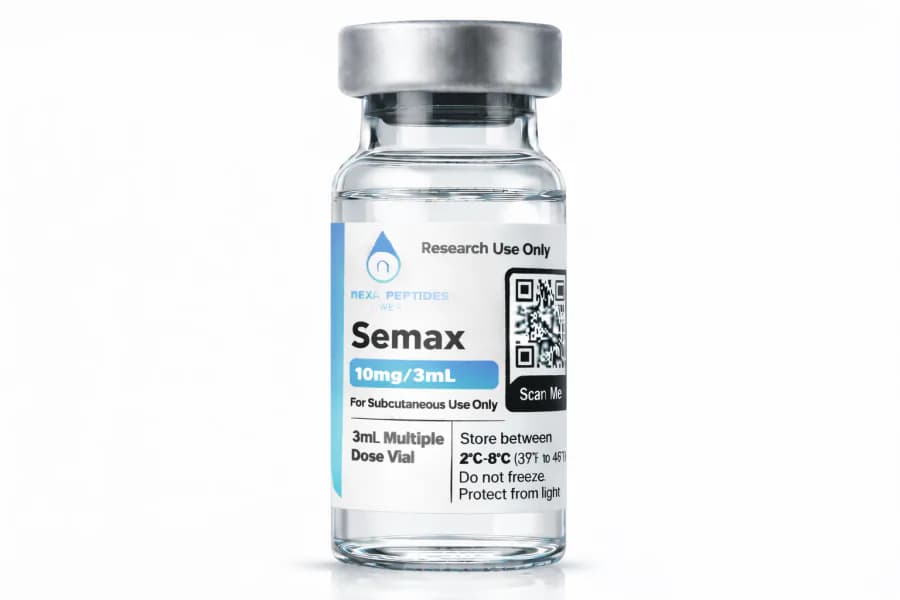
Semax 10mg lyophilized peptide. Synthetic heptapeptide studied for neurotrophic signaling pathways, BDNF activity, and neuromodulatory mechanisms. FOR RESEARCH USE ONLY .
Product Details
Semax is a synthetic heptapeptide analog of the adrenocorticotropic hormone (ACTH) fragment 4-10. Originally developed at the Institute of Molecular Genetics of the Russian Academy of Sciences, it has been the subject of extensive research into cognitive enhancement, neuroprotection, and neuroplasticity.
Studies have examined Semax's effects on BDNF expression, neurotrophic factor modulation, and dopaminergic/serotoninergic pathway activity. Research areas include investigation of cognitive performance under stress, attention and memory consolidation, and neuroprotective responses following ischemic events. Its mechanism involves modulation of multiple neurotransmitter systems and upregulation of neurotrophic factors that support neuronal survival and plasticity.
Each vial contains 10mg of lyophilized Semax, manufactured under strict GMP conditions with purity exceeding 98% as confirmed by HPLC. Additional quality controls include mass spectrometry and bacterial endotoxin testing. Certificate of analysis available upon request.
Storage: Store lyophilized at -20°C. Reconstituted at 2-8°C, use within 60 days.
FOR RESEARCH AND LABORATORY USE ONLY.
About Semax
Semax is a synthetic heptapeptide developed as an analog of the adrenocorticotropic hormone (ACTH) fragment, ACTH(4-10). Its primary amino acid sequence is Met-Glu-His-Phe-Pro-Gly-Pro. Unlike its parent hormone, Semax has been designed to eliminate hormonal activity while retaining and amplifying neuroactive properties. This structural modification, particularly the addition of the Pro-Gly-Pro tripeptide tail, significantly enhances its resistance to enzymatic degradation, prolonging its half-life and bioavailability in research models compared to the native ACTH fragment.
Originally developed for its potential neuroregulatory and cognitive-enhancing effects, Semax has become a significant tool in neuroscience research. It is classified as a nootropic and neuroprotective agent due to its observed effects on central nervous system (CNS) function in a wide range of preclinical studies. Its unique profile allows researchers to investigate mechanisms of learning, memory, attention, and neuronal recovery without the confounding endocrinological effects associated with ACTH.
In the laboratory setting, Semax is investigated for its capacity to modulate key biological processes integral to neuronal health and plasticity. These include the expression of neurotrophic factors, regulation of neurotransmitter systems, and protection against various forms of neuronal stress, such as hypoxia and oxidative damage. Its pleiotropic actions make it a valuable compound for exploring complex CNS pathways.
Nexa Peptides provides Semax exclusively for laboratory and research purposes. This product is not intended for human or veterinary use. Supplied as a lyophilized powder to ensure maximum stability and purity, our Semax allows for precise reconstitution and administration in controlled research environments, enabling reproducible and accurate experimental outcomes. For Research Use Only.
Mechanism of Action
The mechanism of action for Semax is multifaceted, reflecting its ability to modulate multiple signaling pathways within the central nervous system rather than binding to a single receptor target. Its effects are primarily attributed to its influence on neurotrophic factor synthesis, neurotransmitter metabolism, and interactions with specific central receptor systems.
A primary pathway investigated in Semax research is its potent induction of Brain-Derived Neurotrophic Factor (BDNF) and Nerve Growth Factor (NGF) expression and synthesis in various brain regions, including the hippocampus and frontal cortex. By elevating levels of these critical neurotrophins, Semax is thought to activate their respective receptor tyrosine kinases, TrkB and TrkA. Activation of these receptors initiates downstream signaling cascades, most notably the mitogen-activated protein kinase (MAPK/ERK) pathway and the phosphatidylinositol 3-kinase (PI3K)/Akt pathway. These cascades are fundamental to promoting neuronal survival, synaptogenesis, synaptic plasticity, and long-term potentiation (LTP), which are cellular correlates of learning and memory.
Furthermore, Semax has been shown in preclinical models to modulate the monoaminergic neurotransmitter systems. It influences the metabolism and turnover of dopamine, serotonin, and norepinephrine. Research suggests that Semax can selectively increase the activity of these neurotransmitters in brain regions critical for cognitive function and mood regulation. This effect is not due to direct receptor agonism but rather to a complex modulation of neurotransmitter synthesis, release, and reuptake processes, potentially involving interactions with transporter proteins and metabolic enzymes.
As an analog of an ACTH fragment, Semax is also believed to interact with central melanocortin receptors, particularly the melanocortin 4 receptor (MC4R) and melanocortin 5 receptor (MC5R). These G protein-coupled receptors are implicated in attention, cognitive processing, and neuronal protection. The binding of Semax to these receptors may trigger signaling events that contribute to its observed effects on attention and focus in animal models.
In models of cerebral ischemia and neurodegeneration, Semax has been studied for its neuroprotective mechanisms. These include the attenuation of excitotoxicity by modulating glutamate receptor activity, suppression of oxidative stress by enhancing endogenous antioxidant systems, and inhibition of pro-inflammatory cytokine production. Its ability to improve cerebral blood flow, potentially through nitric oxide-dependent pathways, is another area of active investigation for its protective effects in hypoxic and ischemic conditions.
In summary, the biological activity of Semax in research settings is not attributable to a single mechanism but to a coordinated network of effects. It acts as a powerful modulator of neurotrophic, neurotransmitter, and receptor systems, making it a subject of significant interest for studying the molecular basis of cognition and neuroprotection.
Research Applications
Semax is a peptide utilized exclusively in laboratory settings to investigate a broad spectrum of neurological phenomena. Its primary research applications are centered on cognitive enhancement, neuroprotection, and neurorestoration in various preclinical models.
In the field of cognitive neuroscience, Semax is frequently employed in animal models to study its effects on learning, memory, and attention. Researchers utilize behavioral paradigms such as the Morris water maze, radial arm maze, and passive avoidance tests to assess spatial learning, working memory, and long-term memory formation in rodents administered the peptide. These studies aim to elucidate the molecular underpinnings of cognitive processes and how they can be modulated, particularly under conditions of stress or cognitive impairment.
Another significant area of research is neuroprotection, especially in the context of ischemic brain injury. Semax has been extensively studied in models of stroke, such as the middle cerebral artery occlusion (MCAO) model in rats. In these investigations, scientists measure outcomes like infarct volume, neurological deficit scores, and markers of apoptosis (e.g., caspase-3 activity) and oxidative stress (e.g., malondialdehyde levels). The goal of this research is to understand the pathways through which a peptide can confer resistance to or promote recovery from hypoxic-ischemic neuronal damage.
Ophthalmic research represents another key application. Semax has been investigated for its potential neuroprotective effects on the optic nerve and retinal ganglion cells in models of glaucoma, optic nerve crush injury, and diabetic retinopathy. These studies often involve histological analysis, electroretinography (ERG), and measurement of neurotrophic factor levels in ocular tissues to determine if the peptide can mitigate neuronal loss and preserve visual function in experimental models of optic neuropathy.
Furthermore, researchers have explored Semax in animal models designed to mimic aspects of certain neurodevelopmental and psychiatric conditions. For instance, its modulatory effects on the dopaminergic and serotonergic systems have made it a tool for studying the neurobiology of attention and hyperactivity in models relevant to Attention-Deficit/Hyperactivity Disorder (ADHD). These studies aim to dissect the complex interplay of neurotransmitters in regulating executive function and behavior.
The peptide is also used in foundational research to explore gene expression related to neural plasticity and cell survival. In vitro studies using primary neuronal cultures or cell lines allow for detailed investigation of its effects on signaling pathways like PI3K/Akt and MAPK/ERK, and the expression of genes encoding for BDNF, NGF, and other critical neural proteins. These cellular-level studies provide mechanistic insights that complement the findings from in vivo research. All such applications are strictly for non-human, laboratory-based scientific inquiry. For Research Use Only.
Formulation & Handling
Proper handling and storage of Semax are critical to maintaining its integrity and ensuring reproducible results in a research setting. Nexa Peptides supplies Semax as a lyophilized powder, which is the most stable form for long-term storage. Upon receipt, the sealed vial should be stored in a freezer at -20°C to -80°C to prevent degradation. This ensures the peptide's stability for extended periods before reconstitution.
For experimental use, Semax is reconstituted using a sterile, high-purity solvent. The most common choice for research applications is sterile bacteriostatic water, which contains 0.9% benzyl alcohol to inhibit microbial growth. When reconstituting, the appropriate volume of solvent should be slowly injected down the side of the glass vial to avoid agitating the lyophilized powder. The vial should then be gently swirled or rolled between the palms until the peptide is fully dissolved. Vigorous shaking should be avoided as it can cause foaming and potentially lead to the denaturation of the peptide structure.
Once reconstituted, the Semax solution should be stored refrigerated at 2°C to 8°C. In this state, it remains stable for short-term use as dictated by experimental protocols. For longer-term studies requiring use over several weeks or months, it is best practice to create single-use aliquots of the reconstituted solution in sterile microcentrifuge tubes and store them frozen at -20°C or colder. This practice minimizes the number of freeze-thaw cycles, which can degrade the peptide and compromise experimental validity. Always use appropriate personal protective equipment (PPE), including gloves and safety glasses, when handling and reconstituting research peptides.
Quality Standards
At Nexa Peptides, we are committed to providing researchers with Semax of the highest possible quality and purity to ensure the reliability and validity of experimental data. Each batch of our Semax is synthesized and purified to achieve a purity level exceeding 99%, which is rigorously verified using High-Performance Liquid Chromatography (HPLC). The HPLC analysis provides a detailed chromatogram confirming the peptide's purity and identifying any minute impurities.
To further guarantee the product's integrity, the molecular identity and correct amino acid sequence of our Semax are confirmed using Mass Spectrometry (MS). This analysis provides the precise molecular weight of the peptide, ensuring it matches the theoretical value for the Met-Glu-His-Phe-Pro-Gly-Pro sequence. This dual verification by HPLC and MS ensures that researchers receive the exact compound required for their studies.
Our commitment to quality extends to safety and consistency. Every batch undergoes testing for endotoxin levels to ensure it is suitable for sensitive in vitro and in vivo research models. All our peptides are manufactured in a state-of-the-art, cGMP-compliant facility located in the USA, adhering to stringent production standards. Each vial is assigned a unique lot number, enabling complete traceability throughout the manufacturing process. A comprehensive Certificate of Analysis (COA) is available for every lot, providing customers with full transparency and documentation of our quality control testing.
Frequently Asked Questions
What is Semax?
How is Semax synthesized?
What is the molecular weight of Semax?
What research areas use Semax?
How should Semax be stored?
How should Semax be reconstituted for research?
What purity grade is Nexa Peptides' Semax?
Is Semax available with a Certificate of Analysis?
Explore Related Research
Customer Reviews
0 reviews
No reviews yet. Be the first to review this product!